Meeting
Media coverage

CRAFT-VET Quarterly Meeting: Preparing the Next Steps for VET Trainer Capacity Building

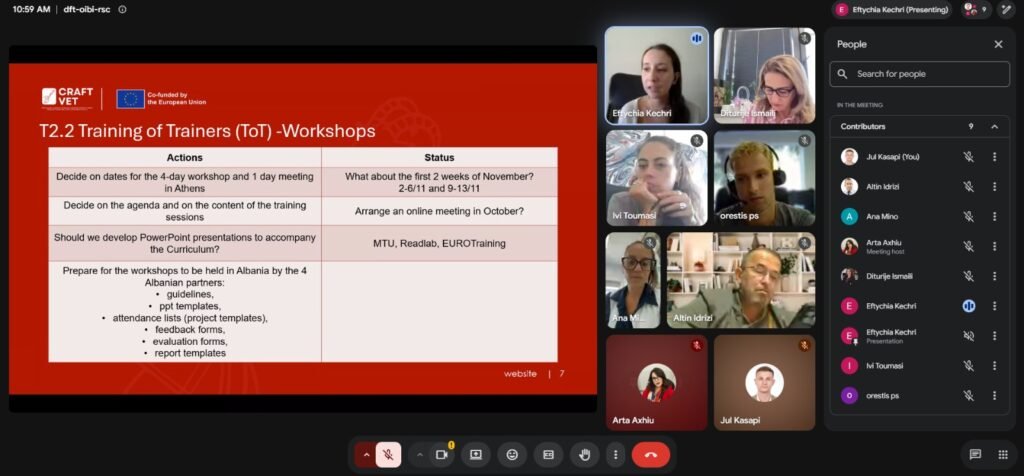
On 24 September 2026, the CRAFT-VET consortium held its quarterly project meeting online, bringing together project partners to review ongoing implementation, coordinate upcoming activities, and ensure that the project continues to progress according to its work plan. The meeting provided an important opportunity for partners to exchange updates on the implementation of CRAFT-VET and to discuss the activities planned for the next phase of the project. A central point of discussion was Activity E1.2 – VET Trainers Training of Trainers (ToT) Workshop, which will bring together VET professionals for an intensive capacity-building programme in Athens, Greece. The activity will also be combined with the Second Steering Committee Meeting, allowing the consortium to connect technical training with project coordination and strategic decision-making. Under the planned activity, five VET trainers from each Albanian partner organisation will participate in the Training of Trainers programme. The mobility is planned as a 4+1-day activity, involving a total of 20 participants. The ToT workshop will focus on several areas that are fundamental to the CRAFT-VET approach: digital tools in craft training, sustainability, circular economy principles, and business and entrepreneurial skills. Through this training, participating VET trainers will strengthen their capacity to integrate modern technologies and innovative teaching methodologies into vocational education, while maintaining a strong connection with traditional craftsmanship and the needs of the labour market. Digitalisation represents an important component of the project. CRAFT-VET seeks to connect traditional craft skills with modern technologies, including digital design and innovative production approaches. At the same time, sustainability remains a cross-cutting priority, with particular attention to reducing waste, promoting environmentally responsible production and introducing circular economy concepts into vocational training. The business dimension is equally important. Trainers will be better equipped to support learners and artisans not only in developing technical skills, but also in understanding areas such as entrepreneurship, branding, market access and the commercialisation of craft products. During the quarterly meeting, partners also discussed the organisational and coordination aspects required for the successful implementation of the upcoming activity. The Steering Committee Meeting 2 in Athens will provide an additional opportunity to review project progress, coordinate responsibilities between partners and agree on priorities for the following implementation period. The quarterly meeting reaffirmed the consortium’s commitment to strengthening cooperation between VET institutions, trainers, artisans and project partners across participating countries. Through activities such as the Training of Trainers workshop, CRAFT-VET continues to build the institutional and professional capacity required to connect artisanal heritage with innovation, sustainability and entrepreneurship, ensuring that vocational education responds to both present and future labour-market needs. DisclaimerCo-funded by the European Union. Views and opinions expressed are however those of the author(s) only and do not necessarily reflect those of the European Union or the European Education and Culture Executive Agency (EACEA). Neither the European Union nor EACEA can be held responsible for them.

Media coverage, Project updates

Designing Skills for the Future: Progress on the CRAFT-VET Training Curriculum

During July and August, the CRAFT-VET partnership worked on the development of the project’s training curriculum, an essential component of its mission to connect traditional craftsmanship with modern technology, sustainable production and new market opportunities. The curriculum is being designed to respond to the needs of artisans, vocational education and training students, trainers and craft businesses. Building on the project’s needs assessment process, the partners focused on creating a practical learning framework that can help participants strengthen their existing competencies while acquiring new skills that are increasingly important in today’s economy. The CRAFT-VET Training Curriculum is intended to be structured around three interconnected learning areas. Digital Skills for Crafts The first area focuses on the use of digital technologies to modernise craft design and production. Participants will be introduced to 3D modelling, AI-assisted design and other digital tools that can support the development of new products, improve production efficiency and reduce unnecessary material use. The curriculum will also explore blockchain-based certification as an innovative method for confirming the authenticity and origin of artisanal products. Such solutions can help protect traditional crafts from imitation while increasing trust among customers and international buyers. Business Development and Market Access Producing a high-quality product is only one part of building a successful craft business. Artisans also need the skills to promote their work, reach customers and compete in markets beyond their immediate communities. For this reason, the curriculum is intended to cover branding, digital marketing, product presentation, customer communication and e-commerce. Participants will learn how online marketplaces such as Etsy and Amazon Handmade operate and how digital channels can be used to reach wider audiences. The training will also introduce relevant aspects of European Union market requirements, including product standards, certification, pricing, sales and export considerations. These competencies will support artisans in presenting their products professionally and exploring opportunities in European and international markets. Sustainability and the Circular Economy The third learning area focuses on environmentally responsible craft production. Participants will explore practical ways to reduce waste, reuse materials and integrate circular economy principles into their production processes. The curriculum will promote the use of upcycled and eco-friendly materials, resource-efficient working methods and the transformation of production leftovers into new products. These approaches can reduce environmental impact while also lowering costs and creating opportunities for innovation. By combining digital skills, business development and sustainability, the CRAFT-VET curriculum aims to offer more than conventional craft training. It will provide participants with an integrated set of competencies that can help them preserve traditional knowledge while adapting to technological, environmental and market changes. The work undertaken during July and August represents an important step towards the preparation of practical and accessible training materials in English and Albanian. Once developed, these resources will support future training activities for VET trainers, students and artisans, as well as practical learning within the planned Smart Craft Labs. Through this curriculum, CRAFT-VET is building a bridge between cultural heritage and the skills required for a competitive, innovative and sustainable craft sector. DisclaimerCo-funded by the European Union. Views and opinions expressed are however those of the author(s) only and do not necessarily reflect those of the European Union or the European Education and Culture Executive Agency (EACEA). Neither the European Union nor EACEA can be held responsible for them.

Co funded by EU

Co-funded by the European Union. Views and opinions expressed are however those of the author(s) only and do not necessarily reflect those of the European Union or the European Education and Culture Executive Agency (EACEA). Neither the European Union nor EACEA can be held responsible for them.

© CraftVET – 2026 by PLEXUS Solutions

Scroll to Top